


AI + Shows = Immersion 2.0: When Performances Feel the Audience
 16.10.2025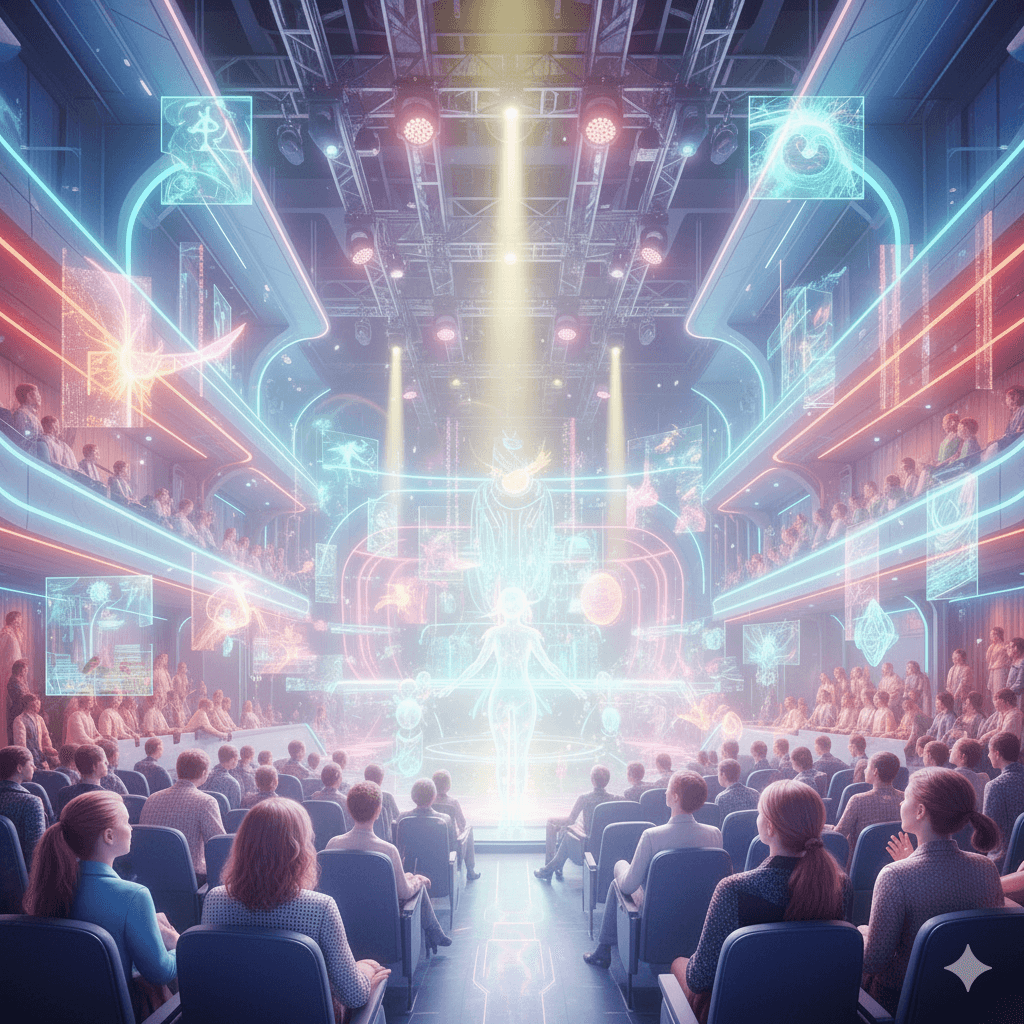
🎬 Introduction
Imagine sitting in a theater. Lights, music, projections surround you.
Suddenly, the light changes in response to your smile.
A hologram turns directly toward you.
That’s not magic — that’s artificial intelligence.
💡 “Shows no longer just perform — they feel the audience.”
Welcome to Immersion 2.0, where technology senses emotions and adapts in real time to each viewer in the room.
📖 Table of Contents
- What “Immersion 2.0” Really Means
- How AI Learns to Feel the Audience
- Global Projects Where AI Reacts to Emotions
- Tech Behind the Curtain
- Emotions as a Script: What’s Next
- What to Expect as Viewers and Artists
- Conclusion
🌀 What “Immersion 2.0” Really Means
Once, immersion meant sound, light, and 3D visuals.
Now, it’s AI interactivity — shows that adapt to audience mood, facial expression, and even voice tone.
The term Immersive 2.0 describes the shift from passive watching to emotional participation.
The show becomes a living organism that senses the collective energy of the crowd.
💬 How AI Learns to Feel the Audience
Modern AI analyzes reactions in real time using multimodal data:
|
Technology |
Function |
Example |
|
Emotion Recognition AI |
Detects micro-expressions and facial cues |
Affectiva, EmotionNet |
|
Voice Sentiment Analysis |
Identifies joy, surprise, boredom by tone |
DeepVoice |
|
Motion Capture + LIDAR |
Tracks gestures and body movement |
Muse, LIDAR stages |
|
Reactive Algorithms |
Dynamically change visuals and sound |
Runway ML, Unreal Engine AI |
🧩 Example:
- When the audience laughs — the stage “blooms” in bright colors.
- When everyone falls silent — the music shifts to a minimalist mood.
🌍 Global Projects Where AI Reacts to Emotions
|
Project |
City |
Unique Feature |
|
The Wizard of Oz at Sphere |
🇺🇸 Las Vegas, USA |
AI adjusts visuals and lighting based on crowd emotion |
|
Silent Echo |
🇬🇧 London, UK |
The storyline changes depending on breathing and heart rate |
|
Deep Symphony |
🇰🇷 Seoul, South Korea |
An AI composer adapts orchestral music to collective emotions |
|
MetaOpera |
🇩🇪 Berlin, Germany |
Cameras track eye gaze; characters react to where viewers look |
|
Sphere 360° |
🇷🇺 Moscow, Russia |
Drones and lights respond to applause and crowd noise levels |
🔗 Sources:
⚙️ Tech Behind the Curtain: Sensors, Cameras, Neural Networks
Key technologies powering these living performances:
- 🎥 Emotion-tracking cameras — EmotionNet, Affectiva
- 🎤 Voice sensors — DeepVoice
- 🧠 Biometric readers — Muse, Empatica
- ⚡ Generative visuals — Runway, Unreal Engine AI Tools
- 🔄 Real-time algorithms — OpenAI Realtime API
🧠 Three data streams work simultaneously:
- Capturing audience reactions
- Emotion analysis
- Real-time feedback — sound, light, video, or story shift
🎭 Emotions as a Script: What’s Next
AI-driven dramaturgy is already here.
Future performances will develop scenes based on the audience’s collective state.
🎡 Emerging directions:
- Smart venues — acoustics and lighting that adapt to audience energy
- Personalized scenes — each viewer sees a slightly different version
- Emotional VR concerts — visuals respond to breathing rhythm
🎙️ “The great artist is the one who feels the audience. Now, AI can too.”
— Adapted from Konstantin Stanislavski
💡 What to Expect as Viewers and Artists
Pros:
- Each show becomes one-of-a-kind
- Deep emotional engagement
- New creative formats and improvisation
Cons:
- Privacy concerns — AI reads faces and emotions
- Possible sensory overload
- Risk of technology overshadowing the artist
🧠 Infographic: How a Show Reads Its Audience
Camera 🎥 → Emotion 😊 → Analysis 🤖 → Reaction 💡 → Effect 🌈
A simple chain showing how human emotion drives stage transformation in real time.
🎬 Conclusion
Entertainment is no longer static.
Artificial intelligence has turned performances into mirrors of human emotion.
We’re no longer just spectators — we’re part of the story.
🌐 Explore more about the future of AI creativity at AIMarketWave.com

