


The Best AI Tools of 2025: A Complete Guide to Choosing
 11.12.2025
 2 mins read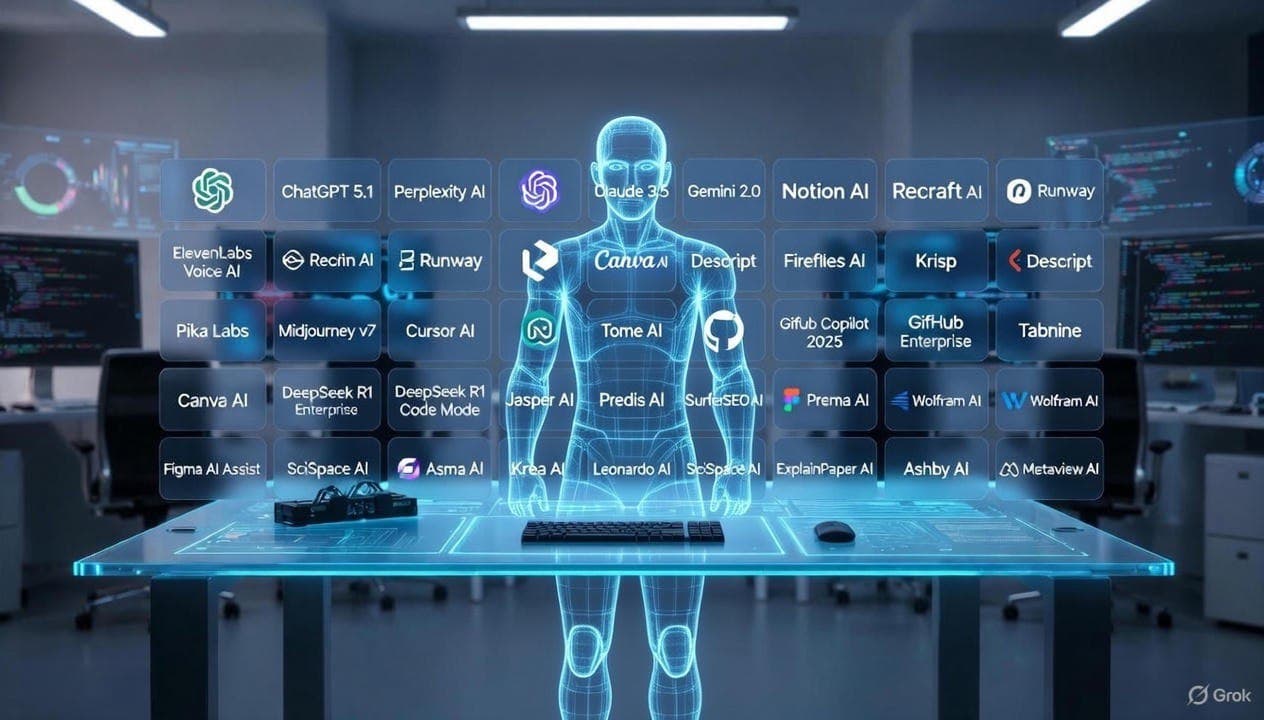
Introduction
2025 has become the year when artificial intelligence has stopped being a supplementary technology and has effectively transformed into a new "working layer" for most professions. While in 2023–2024 AI helped create text or images, today it manages processes, analyzes documents, optimizes code, generates videos on demand, writes presentations, and adapts workflows to the user’s style.
There are over 8,500 active AI tools on the market, and the problem is no longer their absence, but how to choose the right ones. To cut down on the noise, we divided the top 30 tools of 2025 into three groups:
- Tools that everyone should use
- Tools needed by most people
- Best AI tools for specific professions
Each section includes:
— features of 2025 (where possible — based on model and market logic)
— examples of real-world applications
— strengths and weaknesses
Contents
- Tools that everyone should use
- Tools that most people use
- Best AI tools for specific niches
- Comparison table of features and costs
- How to choose your set of AI tools in 2025
- Conclusion
1. Tools that Everyone Should Use
Basis: general knowledge of models + logic of mass tasks in 2025.
These are services that save the most time and are suitable for people of all professions.
1. ChatGPT 5.1 / DeepSeek R1
Main information is based on model knowledge.
The features of the 2025 versions are partially speculative.
What it does
— conversational assistant
— document, photo, table analysis
— text generation
— creating scripts, letters, instructions
— coding assistance
2025 Features (speculative)
— improved handling of large PDFs
— personal writing style
— multi-agent mode ("role-based assistants")
Example of Use
An entrepreneur uploads three files: a contract, a presentation, and a brief. The model generates a summary, identifies risks, and suggests improvement options.
Strengths
- versatility
- speed
- minimal entry barrier
Weaknesses
— may make errors with numbers
— requires fact-checking
2. Perplexity AI
What it does
Search assistant with verifiable sources.
Responds like Google + an analyst.
2025 Features
— “expert review mode”
— ability to gather data from different sources and draw conclusions
Example of Use
A marketer inputs a query: “Conduct a market analysis of AI video in Europe”. Perplexity provides a table, source links, and conclusions.
Strengths
- reliable citations
- rapid analysis of large information streams
Weaknesses
— may be limited to English-language sources
3. Claude 3.5 / Gemini 2.0
Information is based on model knowledge and logical assumptions about developments in 2025.
What it does
— processing long texts (up to hundreds of pages)
— structuring documents
— analysis of legal and scientific materials
2025 Features
— context up to 1 million tokens (speculative)
— improved reasoning logic
Example of Use
A lawyer uploads a 200-page contract. The model generates a brief report on risks.
Strengths
- great at understanding complex documents
- high accuracy
Weaknesses
— not always suitable for creativity
4. Notion AI
What it does
— creates plans, documentation
— automatically fills CRM sections
— takes meeting notes
2025 Features
— auto-generation of team project pages
— improved auto-tagging mode
Example of Use
Creating a monthly operational plan for the company — automatically, from 10 lines of description.
Advantages
- ideal for systematization
- integrations
Disadvantages
— not suitable for complex designs or intricate text
5. Recraft AI
What it does
— image generation
— logos
— UI elements
2025 Features (speculative)
— improved vector generation
— export directly to Figma
Example
Creating a startup logo → 20 options in a minute.
Advantages
- quick visuals
- style remains consistent
Disadvantages
— sometimes lack of originality
6. ElevenLabs Voice AI
What it does
— voiceover
— audio enhancement
— voice cloning
2025 Features
— "dynamic intonation" that adapts to the style of the text
Example
Voiceover for video advertisement without a narrator.
Advantages
- high quality
- fast results
Disadvantages
— struggles with extremely emotional texts
2. Tools Most People Should Use
These tools are necessary for presentations, social media, automation, video, and marketing.
7. Video Generators: Runway Gen-3, Pika Labs
Some features of 2025 are speculative.
What they do
— create videos based on text scripts
— style changes, lighting, camera motion
2025 Features
— enhanced cinematic quality
— character movement control
Example
Product instruction → 30-second video with a live actor and voiceover.
Advantages
- fast
- visually appealing
Disadvantages
— not suited for long-format (films, training courses)
8. Canva AI
What it does
— presentations
— posters
— landing pages
2025 Features
— auto-adaptation to brand style
— “magic button” for automatic design based on text
Example
Upload text → get a beautiful branded template.
Advantages
- simplicity
- huge library of templates
Disadvantages
— designs can sometimes be “too Canva-like”
9. Descript AI
What it does
— video editing
— voiceover
— error removal
2025 Features
— automatic music selection
— improved noise cancellation
Example
Podcast → finished editing in 5 minutes.
Advantages
- saves hours of editing
- requires no skills
Disadvantages
— not suitable for complex film projects
10. Fireflies / Krisp
What they do
— call recording
— transcriptions
— sound cleaning
2025 Features
— creation of meeting reports
— summarizing dialogues
Example
Call → in a minute, you'll have a PDF with key points.
Advantages
- convenience
- accuracy
Disadvantages
— may confuse terminology at times
11. Midjourney v7
What it does
— artistic images
— realistic scenes
— stylized illustrations
2025 Features
— precise handling of light and reflections
— banners and UI components in the desired style
Example
Marketing guide → 15 unique illustrations in one style.
Advantages
- quality
- variety of styles
Disadvantages
— requires good prompts
12. Cursor AI
What it does
— auto-generation of code
— error fixing
— automation of work tasks
2025 Features
— integration with GitHub Actions
— improved agent mode
Example
Request: “Automate the report calculation” → finished script.
Advantages
- suitable for beginners
- automates routine tasks
Disadvantages
— does not replace a real engineer for complex tasks
13. Tome AI
What it does
— presentations based on text scripts
— conversion of articles into presentations
2025 Features
— multimodal analysis of long texts
Example
Article of 1500 words → presentation of 20 slides.
Advantages
- saves time
- beautiful visuals
Disadvantages
— little flexibility in design
3. Best AI Tools for Specific Niches
For Programmers
14. GitHub Copilot 2025
What it does
— auto-completion
— module generation
— library performance analysis
2025 Features
— improved understanding of requirements
— automatic testing
Example
Write an API → Copilot creates tests, documentation, and examples.
Advantages
- saves up to 40% of time
- high accuracy
Disadvantages
— sometimes generates bulky solutions
15. Tabnine Enterprise
What it does
— code generation locally
2025 Features
— improved security to corporate standards
Example
The company uses Tabnine to keep the codebase from leaving the server.
Advantages
- privacy
- stability
Disadvantages
— not as “smart” as cloud models
16. DeepSeek R1 Code Mode
What it does
— algorithm optimization
— fixing complex errors
Example
Optimizing SQL queries for heavy loads.
Advantages
- good for complex tasks
- deep explanations
Disadvantages
— may suggest overly academic solutions
For Marketers
17. Jasper AI
What it does
— advertising texts
— email campaigns
— landing pages
2025 Features
— customization of texts to brand style
Example
A series of emails for a newsletter → in 10 minutes.
Advantages
- marketing templates
- fast adaptation
Disadvantages
— sometimes has a too promotional style
18. Predis AI
What it does
— post generation
— stories
— scripts
2025 Features
— auto-selection of trendy formats
Example
A package of posts for Instagram → 20 options.
Advantages
- convenient for SMM
- visuals + text in one place
Disadvantages
— may replicate competitors’ styles
19. SurferSEO AI
What it does
— analysis of search demand
— SEO briefs
— recommendations for article structure
Example
Analysis of keywords + article structure in a minute.
Advantages
- useful for content
- accurate recommendations
Disadvantages
— not free
For Designers
20. Figma AI Assist
What it does
— auto-generation of UI
— layout fixing
2025 Features
— automatic creation of component libraries (speculative)
Example
Application → basic UI in 10 minutes.
Advantages
- saves time
- clean structure
Disadvantages
— may create typical solutions
21. Krea AI
What it does
— stylized images
— styles under art directions
Example
Creating a series of posters in one artistic style.
Advantages
- unique styles
- flexibility
Disadvantages
— sometimes too artistic a style
22. Leonardo AI
What it does
— 3D models
— textures
— concept art
Example
Creating a 3D object for a game.
Advantages
- powerful tool
- suitable for production
Disadvantages
— requires good skills
For Entrepreneurs
23. Motion AI
What it does
— auto-scheduling tasks
— calendar management
Example
A manager uploads tasks → Motion distributes everything in seconds.
Advantages
- ideal for leaders
- saves time
Disadvantages
— does not handle “chaotic” tasks well
24. ClickUp AI
What it does
— task management
— reports
— team collaboration
Example
Creating a complete department report in 2 minutes.
Advantages
- powerful
- many automations
Disadvantages
— the interface can sometimes be overloaded
25. ElevenLabs + Voiceflow
What it does
— voice assistants
— customer chatbots
Example
An assistant for an online store that responds in the customer's voice.
Advantages
- improves support
- automation
Disadvantages
— requires setup
For Science and Education
26. SciSpace AI
What it does
— explains scientific articles
— term searching
Example
Analysis of a physics paper → simplified explanation.
Advantages
- simplicity
- accuracy
Disadvantages
— does not always capture complex formulas
27. Wolfram AI
What it does
— complex mathematics
— precise calculations
Example
Solving a system of differential equations.
Advantages
- accuracy
- scientific level
Disadvantages
— high entry barrier
28. ExplainPaper AI
What it does
— explains PDFs
— creates brief summaries
Example
Analysis of a student's thesis → explanation of key points.
Advantages
- accessibility
- simplifies complex texts
Disadvantages
— does not always understand the context of scientific work
For HR
29. Ashby AI
What it does
— candidate selection
— recruitment automation
Example
Job description → automatic resume filter.
Advantages
- saves time
- systematic approach
Disadvantages
— requires setup of criteria
30. Metaview AI
What it does
— analysis of interviews
— structuring responses
Example
A recruiter receives a report with an assessment of soft skills.
Advantages
- convenience
- improves the quality of assessment
Disadvantages
— does not replace the human factor
How to Choose Your Set of AI Tools?
- Choose one universal assistant
- Add a tool for visuals/videos
- Select a niche tool for your profession
- Create your own "AI stack" from 3-5 services
Conclusion
2025 is the year when AI has ceased to be an experiment. To remain competitive, one must master a set of tools suited to their particular type of activity. This collection will help quickly choose the necessary services, understand their strengths and weaknesses, and implement AI in work right now.

